
Plural's €1bn fund is a bet on the European companies that sell defence, energy and compute to a continent that has become a major buyer.
Plural's €1bn fund is a bet that Europe's shift from buyer to builder will reward the companies selling defence, energy, space and AI infrastructure to the continent. About €667m sits in Fund III, an early-stage vehicle, and €333m in a follow-on opportunities fund.
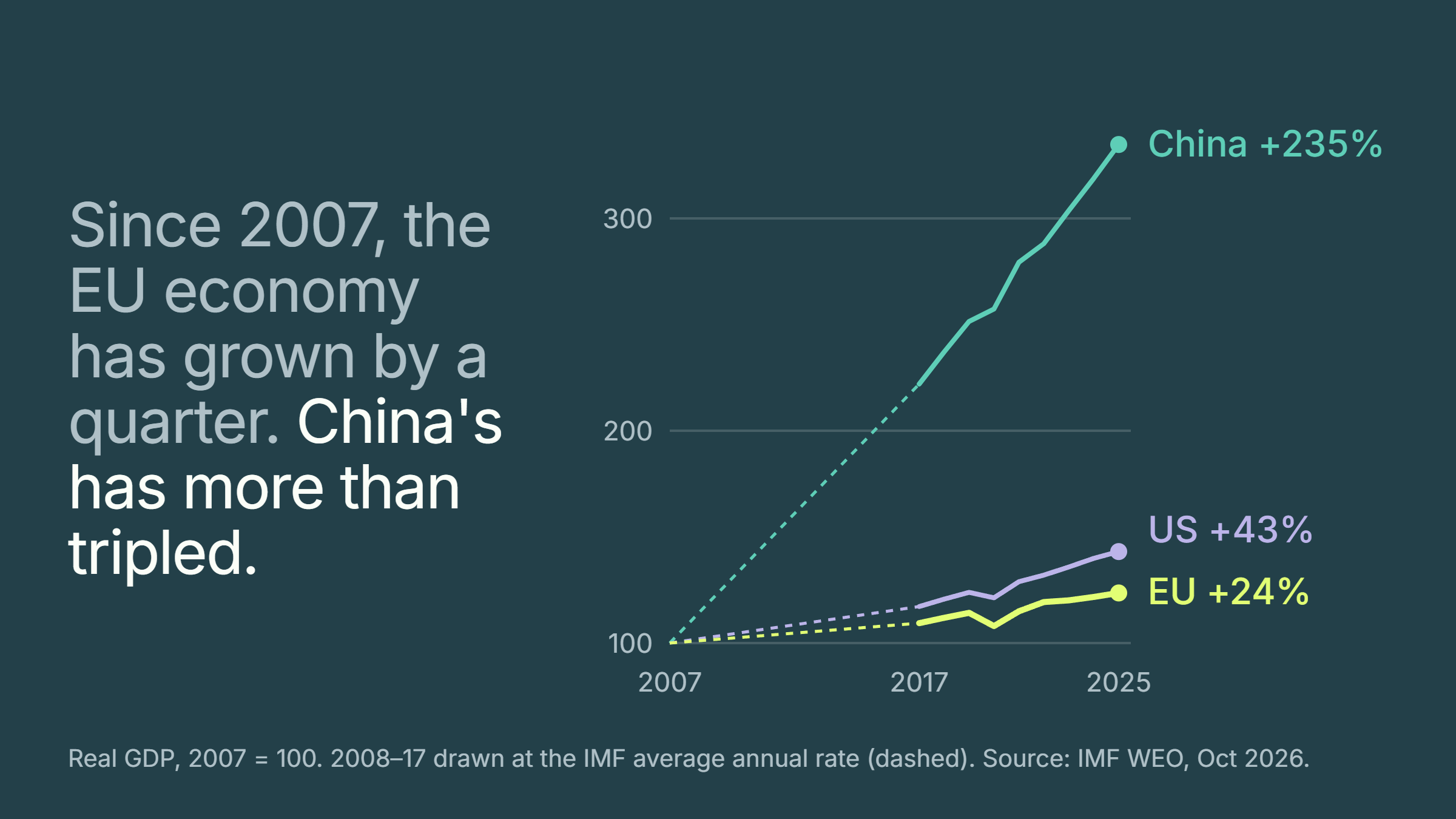
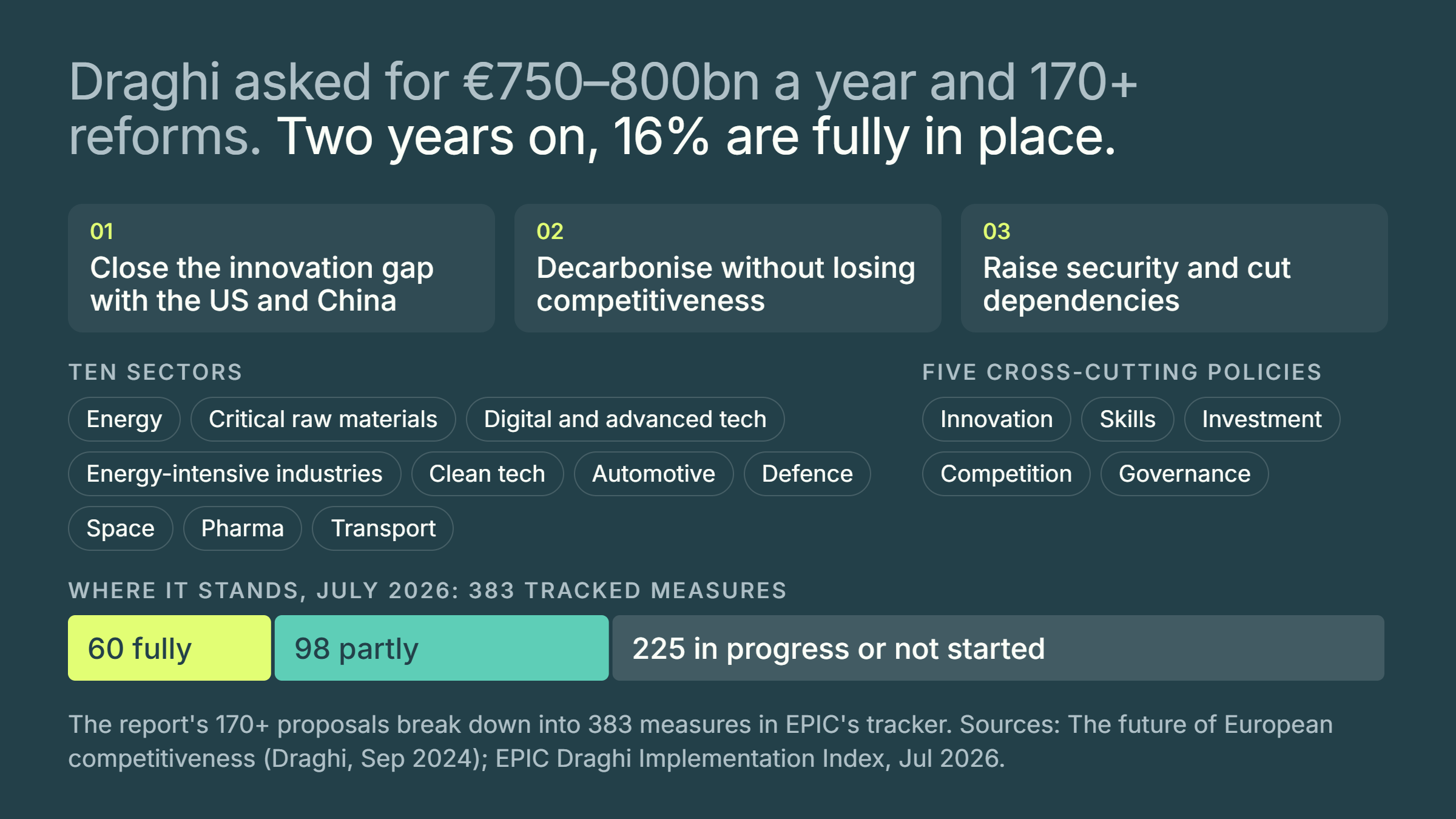
Since the eve of the financial crisis, the US economy has grown by more than 40% in real terms and China's has more than tripled. The EU's has grown by about a quarter. Mario Draghi put a price on closing that gap in September 2024: €750 to 800bn a year of extra investment, around 4.5% of GDP, a rate Europe has not sustained since the 1970s.
The gap shows up as lost ground in industries where Europe has long been strong. Chinese brands took about 15% of Europe's new-car market in September, from about 3% in 2024. Europe has announced the closure of around a tenth of its chemical capacity since 2022 and replaced almost none of it. Its share of global chip production is forecast to barely move this decade, despite the Chips Act that set a goal of 20% of global production value by 2030 and drew about €86bn of public and private commitments, only around €4.5bn of it managed directly by the EU.
Over the same years, Europe has become one of the largest customers in the world for the things it lacks. Member states' defence spending is projected at €454bn this year, and NATO's new target would take it far higher. The Commission says energy grids need €584bn by 2030, and its AI programme aims to mobilise €200bn. Part of that demand is now steered towards European suppliers by law.
Which side of that ledger investors end up on depends on how quickly Europe turns its spending into contracts, and how easily it lets the companies that win them grow. Plural has just raised €1bn on the view that it will move quickly enough.
What is in Plural's €1bn fund, and how is it split?
In November 2026, Plural announced 1bn of new capital. About €667m goes into Fund III, its third early-stage vehicle. The other €333m or so goes into a separate opportunities fund. An opportunities fund is a follow-on vehicle that can only invest further into companies Plural already owns rather than back new ones. Partners Khaled Helioui and Carina Namih say the split is fixed.
Plural is four years old and has now raised €1.76bn across three funds, each roughly double the last. Endowments and foundations are its largest group of LPs, and Fund II investors came back with more than 125% of their earlier commitments.
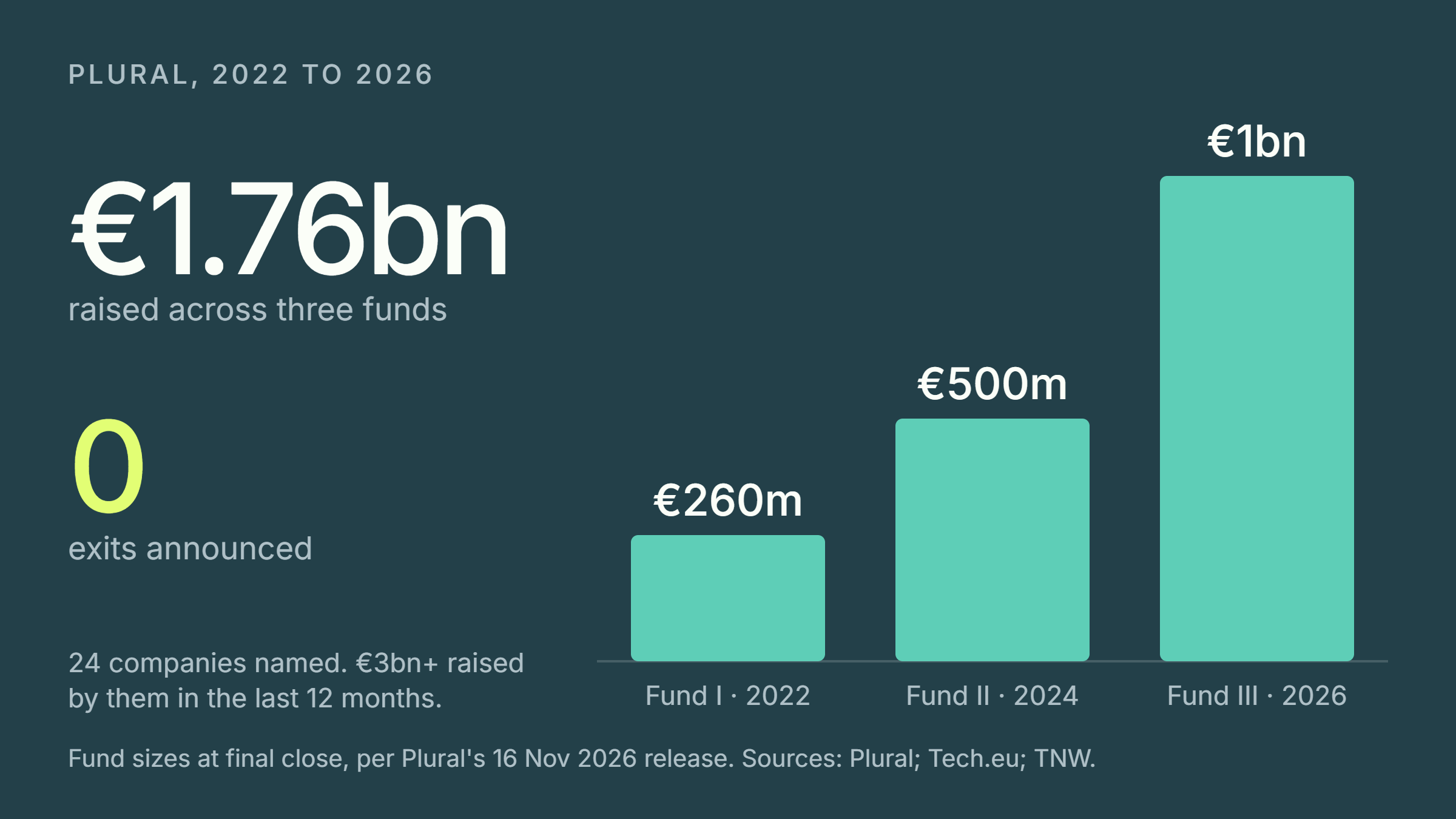
Fund III expects to back 25 to 35 companies across six partners, while Fund I made 31 investments with five. Two and a half times the capital for roughly the same number of bets works out at about €22m of commitments per company in Fund III, or €33m once the opportunities fund is counted. Plural is keeping the number of bets roughly where it was and scaling its ability to stay in the ones that work.
Fund I: 31 investments, five partners, about €8m per company.
Fund III: 25 to 35 companies, six partners, about €22m per company, or €33m with the opportunities fund.
What does Plural think Europe is for?
Plural's Fund III page puts the premise in one line: "Europe has been a customer rather than a creator." The sectors are defence, energy, space and AI infrastructure, with robotics and health added in press briefings. The 24 companies Plural names in its announcement read the same way, though Plural has not yet announced an exit.
The longer version is a June 2025 essay by Helioui on The Exploration Company. It opens: "The past decade has been a challenging one for European sovereignty." His argument is that Europe now depends on others for industrial output, energy and border defence because, in the last industrial cycle, "we failed to show ambition by institutionally supporting driven entrepreneurs". The advantage he points to is talent, after decades of public space spending left what he calls a "world class talent base". Plural's other claim is that the missing input is operator judgement. It cites a figure that about 8% of European investors are former operators, against more than 50% in the US.
Plural partner Sten Tamkivi has described the capital problem simply and directly. A software start-up can prove itself on a €1.5m seed round. A fusion, hypersonics or chip company may need well over $20m to reach its first hardware milestone. The opportunities fund is the answer to that arithmetic, because it lets Plural keep its stakes through Series B and beyond rather than hand them to American growth funds.
The thesis has also moved. Fund I was less defence-focused and held AI, climate and consumer companies. The turn to hardware and deep tech came with Fund II, as European defence budgets and defence valuations rose together. Taavet Hinrikus says the firm does "not pretend to know in which area the next great company will be built". The portfolio is more concentrated than that suggests: 16 of the 24 companies Plural names sit in defence, energy, space or compute. In practice, Fund III is a bet on the strategic state as customer.
There is a strong case for that bet. Plural joined Helsing's $1.8bn round in July, at an $18bn valuation. Government budgets committed to buying reduce demand risk in a way consumer or software investing rarely can, though a budget line is not the same as a signed contract. The risk that remains is timing. Procurement still runs through 27 national ministries, each on its own budget cycle, and that fragmentation slows the conversion of political will into revenue.
What Draghi was diagnosing
Draghi diagnosed three gaps holding Europe back: innovation, energy and security. In short, Europe trails on research and scale, pays far more for energy, and depends on others for defence and chips. The innovation gap comes first. His report is usually remembered for its price tag, but by Banco de España's count about half of his proposals need no additional public investment at all. Only four of the world's 50 largest technology companies are European. EU companies spent €270bn less on research and development than their US counterparts in 2021, and close to 30% of the unicorns founded in Europe between 2008 and 2021 moved their headquarters abroad, mostly to the US.
The second gap is energy. European companies pay two to three times as much as American ones for electricity and four to five times as much for gas, which turns decarbonisation into an industrial cost problem as well as a climate one. The third is security. Between 75% and 90% of the world's wafer fabrication capacity sits in Asia. Defence is fragmented too: Europe builds twelve types of battle tank to America's one, and between mid-2022 and mid-2023, 78% of EU defence procurement spending went to suppliers outside the EU, 63% of it to the US.
The opportunity sits on the other side of the same diagnosis. The extra investment Draghi called for, around 4.5% of GDP a year, is more than double what the Marshall Plan contributed at its peak. The savings exist: European households save more than American ones, but their wealth has grown by only a third as much since 2009. Draghi's explanation was that capital markets are too fragmented to channel those savings into European companies. A year after the report came out, he said Europe was "in a harder place" and blamed complacency for the slow progress. The sections that follow take his three gaps in turn, starting with where Europe has lost the most ground.
Where is Europe losing the most ground?
Draghi's energy gap bites hardest in energy-intensive industries such as chemicals, where power and gas are a large share of costs. Scale compounds it: China now makes more of the world's manufactured value than the US, Germany and Japan combined.
Cars show what happens when Europe's answer is to defend. The Commission opened its case against Chinese battery-electric cars in October 2023 and imposed duties of 17.0% to 35.3% a year later. Chinese brands' share held near 3% while the case ran, then more than quadrupled. Because the duties only covered battery-electric cars, growth moved into hybrids, which went from 23% to a third of Chinese-brand sales in a year. A safeguard investigation covering hybrids from all countries opened on 30 October 2026 and is not expected to reach a decision before mid-2027.
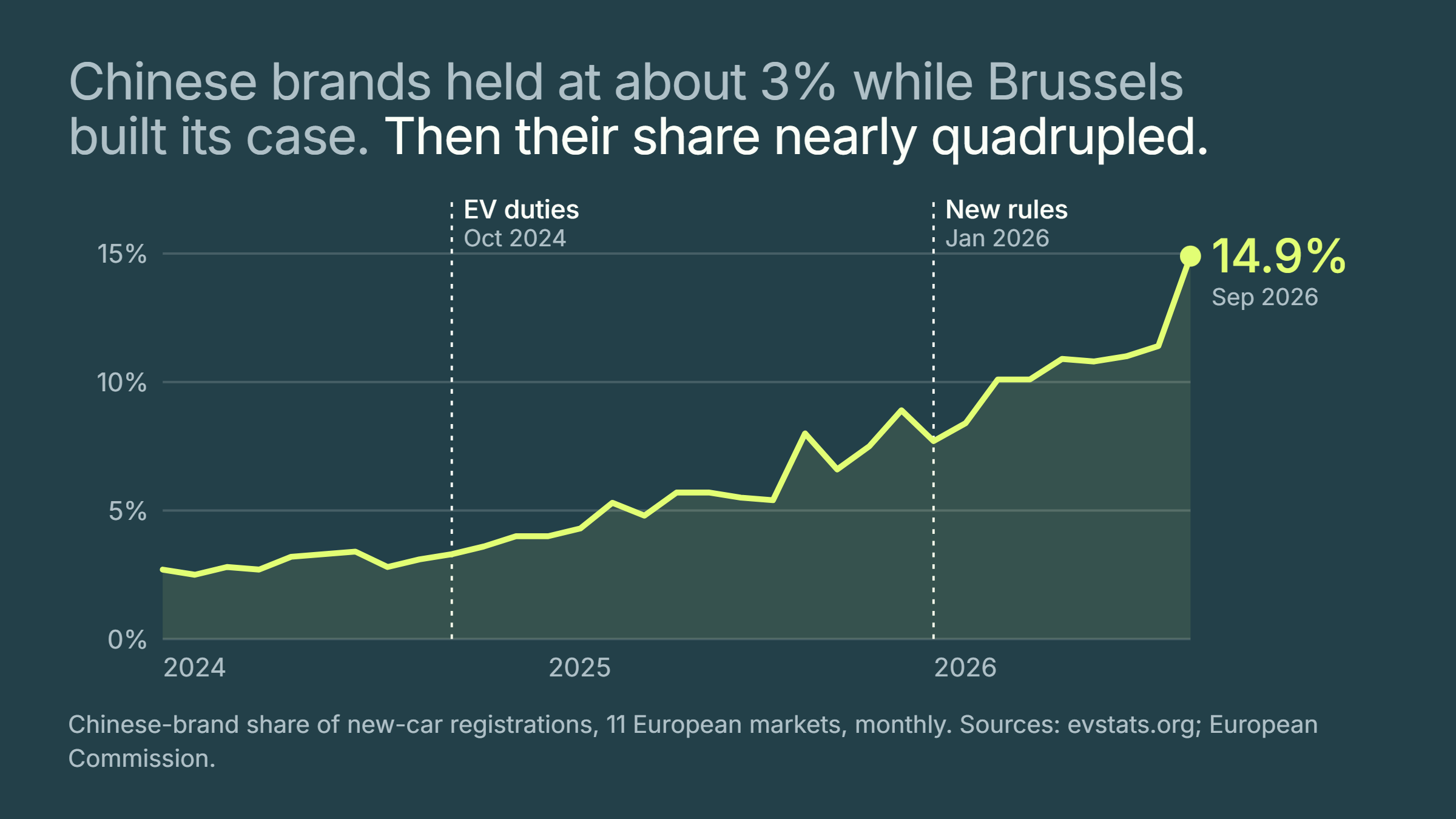
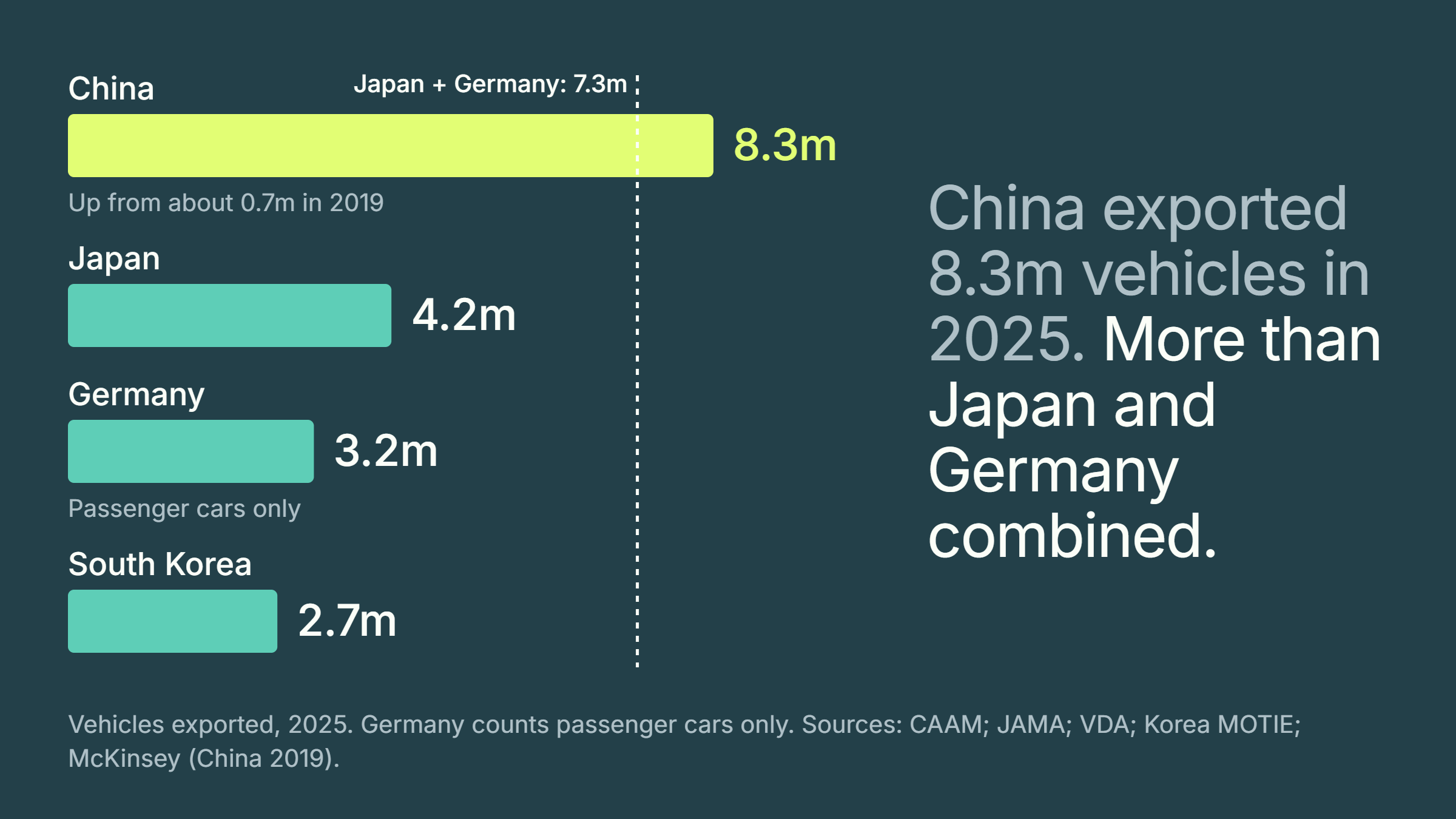
The duties had limited effect because the underlying advantage is cost and scale. China exported 8.3 million vehicles in 2025, more than Japan and Germany combined, and Europe is just one of its markets. What Chinese makers bring is a cost base the IEA puts about 30% below Germany's, built on scale, cheaper labour and battery manufacturing know-how. Energy is only 1 to 4% of the cost of building a car, so this gap is not mainly about energy prices. Against a cost gap of around 30%, a 17% duty narrows the advantage rather than closing it, and Chinese brands' share held steady for about a year after the duties before it started to climb.
Where is Europe buying?
Europe moves fastest when it is the buyer. Defence spending by member states rose 20% in real terms in 2025 and is projected to reach €454bn in 2026. If the full EU met NATO's 3.5% core spending target, that figure would climb towards €665bn a year at current GDP levels. The direction of that money is also being shaped by law: the SAFE defence loan programme, an EU scheme that lends member states money to buy defence equipment together, requires at least 65% of component costs to come from the EU, the EEA or Ukraine, which builds a legal preference for European suppliers directly into the funding rules.
Research is the thin part of the defence budget, about 4% of spending, and it is where start-ups are moving in. European defence, security and resilience start-ups raised a record $8.7bn in 2025, up 55% in a year when European venture as a whole grew 16%. Defence is also where Brussels has made the fastest progress on Draghi's agenda over the past year, on Banco de España's reading of the EPIC data.
Why back the builders now?
The pattern across both sectors is clear. In cars, shielding incumbents from a cheaper rival bought roughly a year before Chinese brands' share began climbing again. In defence, where Europe is spending on things it cannot yet build itself, budgets rose 20% in real terms in a single year and a legal preference for European suppliers was written directly into the funding rules. Plural's framing, that Europe has been a customer rather than a creator, captures the problem. It also captures the opportunity. Hundreds of billions of euros a year in public and regulated spending is looking, by law and by policy, for European suppliers. The question is how quickly European companies can position themselves to win it.
Venture capital cannot fix a chemicals plant's energy bill or close a 30% cost gap in car assembly. It can back companies that sell into defence budgets, grid build-outs and AI compute, along with the industrial software and robotics that could lift productivity in the factories Europe still has. That is where Plural has put its money, and at roughly €22m per company in Fund III against about €8m in Fund I, it can stay in those companies through more rounds than it could before.
The timetable is the real risk. Two years after Draghi's September 2024 report called for €750 to 800bn a year of extra investment, 15.7% of his 383 recommendations are fully in law, and the pace has slowed. The capital-markets package is not expected to be settled before 2027, and EU Inc, the proposed optional EU company structure, has been watered down in the areas that matter most to fast-growing companies. None of that blocks a defence company from winning contracts today. But it shapes where a company eventually lists, and whether it stays European once it reaches scale. Europe builds them, then loses them.
What would winning look like for this fund?
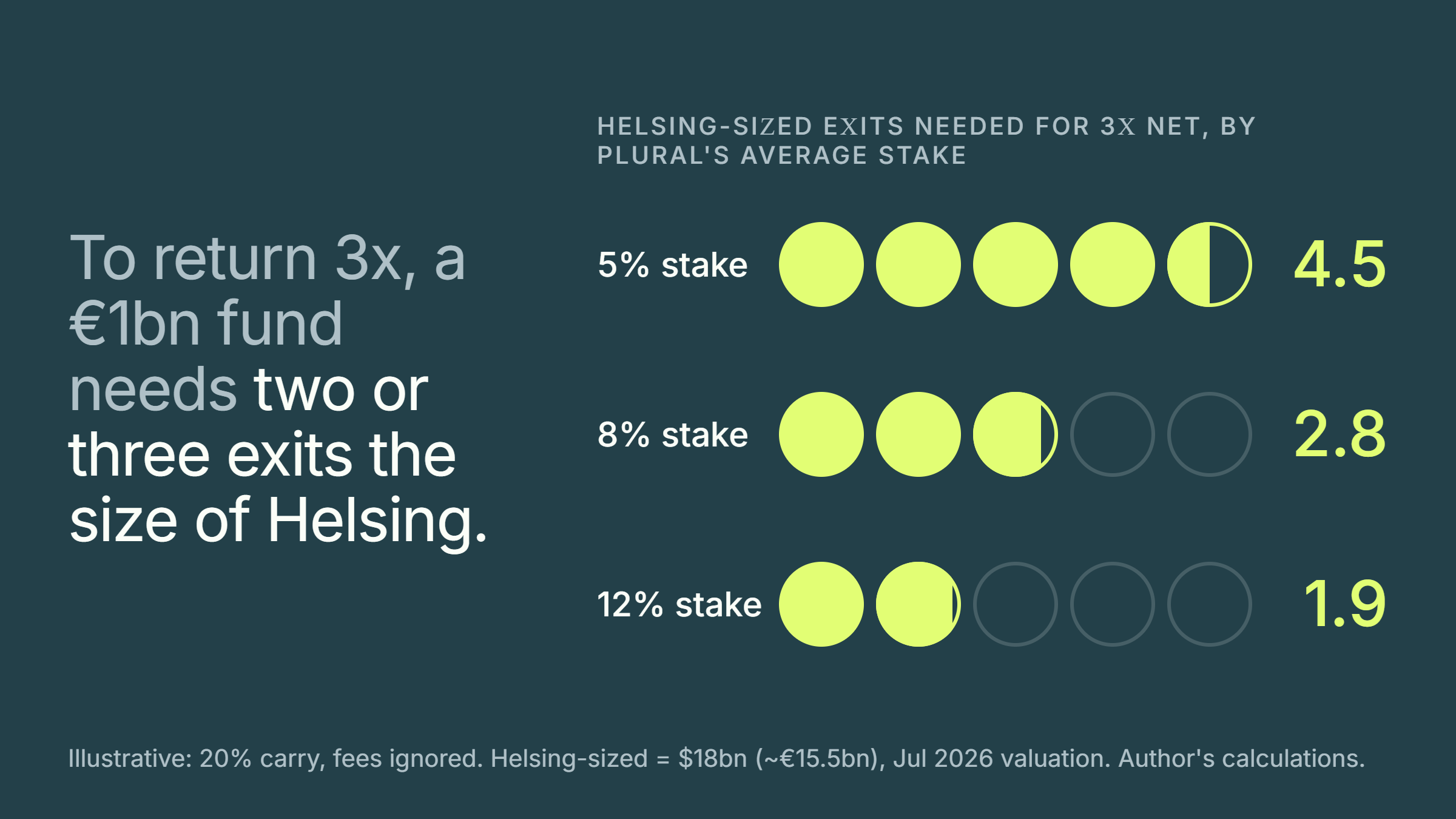
The exit maths shows the size of the prize and how concentrated it has to be. On a simple set of assumptions, a 3x net return on €1bn would need around €3.5bn of gross proceeds. This is illustrative, not a forecast, most venture funds do not reach it, and Plural has announced no exits yet. At an 8% average stake in the winners, that means about €44bn of exits: two or three companies the size of Helsing, sold or listed.
Helsing's valuation moved from around €5bn in mid-2024 to $18bn this July, which gives a sense of how fast private prices in this space have shifted. The same year saw Helsing raise $1.8bn, The Exploration Company raise $450m, and Plural's portfolio companies collectively raise more than €3bn. These are private market valuations, not exit prices, and Plural has not yet announced a sale or listing. The real test comes when acquirers or public markets set the price. By building a fund specifically to hold its winners longer, rather than selling early to American growth investors, Plural is taking on more of that uncertainty directly.
Further down the stack
For smaller managers, the opportunity sits below Plural. The surge in European venture in the third quarter went almost entirely into late-stage rounds, while early-stage and seed funding were flat. Capital is arriving near the top of the market, but the companies that will eventually need it are set much further down. Most will still need someone willing to take on technical risk early, at prices that make sense before a contract is signed. Managers who do that well now have a larger pool of potential follow-on buyers than they did three years ago, which means entry terms carry more weight than they used to. The capital constraints are also real. A €30m fund cannot get a chip company to a $20m hardware milestone on its own. Reserves and syndicate partners need to be part of the plan from the start.
The LP base is worth watching. Plural's largest LP group is endowments and foundations, including the University of Michigan, and Helsing's latest round was reportedly led by US growth investors. At least part of the capital behind European strategic technology is still American. The Savings and Investments Union reforms are meant to move more European savings into European companies. If they work, managers already in these companies are well placed. What to watch next: the EU capital-markets package due in 2027, whether SAFE's local-content rules hold, and whether early-stage pricing stays sensible as late-stage capital floods in.
Common questions about Plural's €1bn fund
How does the opportunities fund differ from Fund III?
Fund III backs new early-stage companies, while the opportunities fund can only follow on into companies Plural already owns. The split is fixed at about €667m to Fund III and €333m to the opportunities fund.
What does SAFE's local-content rule mean for suppliers?
SAFE is an EU scheme that lends member states money to buy defence equipment together. It requires at least 65% of component costs to come from the EU, the EEA or Ukraine, which builds a legal preference for European suppliers into the funding rules.
For more on the themes Plural is backing, see our pieces on whether robots can keep the AI boom alive, why the Nordics punch above their weight, and finding venture returns in the shadow of AI giants.
What we've been working on at Shuttle
Next week we're going public with our biggest update to date, keep an eye on our socials next week
This article is for information only. It is not investment, financial, legal or tax advice.